


Exploring the Golden Triangle: Three Cities of Timeless Elegance.
- Sreejith TR
- Jul 12, 2025
- 17 min read
Imagine tracing the footprints of emperors as the first morning light gilds the ivory marble of the Taj Mahal. Picture yourself navigating the bustling lanes of Old Delhi, where centuries of history whisper from behind sandstone walls, only to find serenity in the rose-red ramparts of Jaipur’s Amber Fort. This is the Golden Triangle—India’s crown jewel of cultural heritage, architectural marvels, and timeless traditions. Which stretches in a perfect arc between
Delhi, Agra, and Jaipur.

Within days, you’ll indulge in a symphony of heritage, opulence, and wonder-from savouring spicy chaat beneath ornate Mughal archways, to wandering through royal palaces that echo with the laughter of bygone maharajas. Whether you seek the romantic allure of the Taj, the imperial grandeur of Delhi’s colonial monuments or the fairytale vibrancy of Rajasthan’s Pink City, the Golden Triangle offers an unforgettable tapestry of sights, sounds, and flavours.
Join us as we embark on a journey through northern India’s most celebrated circuit—where every turn reveals a new story, and every sunset promises yet another breathtaking view. Let the Golden Triangle awaken your wanderlust.
Delhi - A Royal Welcome to India’s Timeless Capital

Delhi is where India’s past and present meet in a vibrant, unforgettable rhythm. From the grand Mughal monuments and colonial-era avenues to the bustling bazaars and world-class dining, the city offers a rich tapestry of experiences. Wander through the majestic halls of Humayun’s Tomb, savour street food in Old Delhi, and unwind in the comfort of a luxury hotel overlooking the city’s skyline. Whether you’re tracing the footsteps of emperors or sipping chai in a quiet garden, Delhi invites you to explore its history, culture, and modern charm—all in one captivating journey.
Humayun’s Tomb : Where symmetry meets serenity.
Experiencing Humayun’s Tomb is like stepping into a timeless sanctuary of Mughal elegance. As you enter the complex, a sense of calm sets in—the buzz of Delhi fades, replaced by the gentle rustle of neem trees and the rhythmic crunch of gravel underfoot. The monument rises ahead of you in perfect symmetry, its red sandstone facade inlaid with white marble gleaming softly under the morning sun.
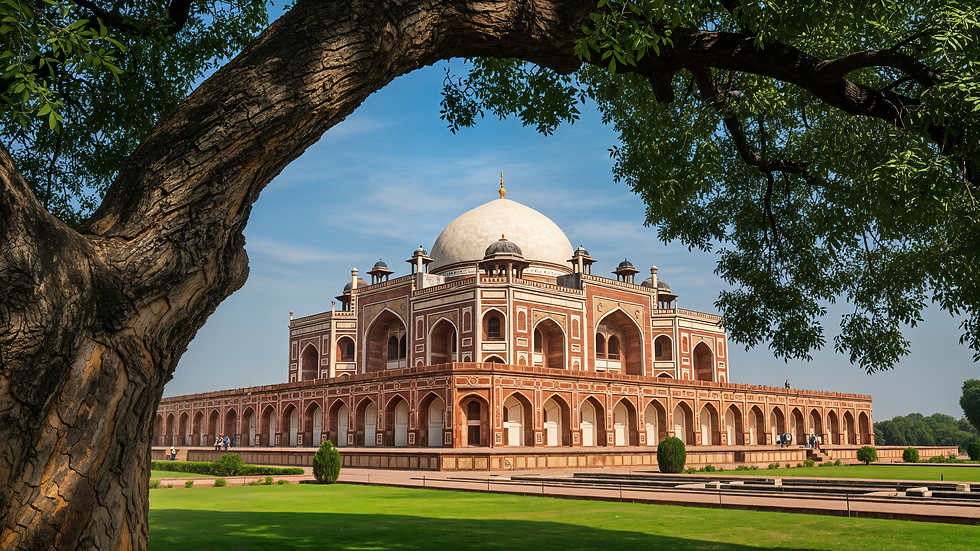
Built in the 16th century and often considered the architectural precursor to the Taj Mahal, the tomb sits at the heart of a grand Persian-style garden, divided by water channels and pathways—a symbol of paradise in Islamic tradition. As you walk along the shaded paths, birds flit through the air, and the quiet hum of history surrounds you. Up close, the intricate latticework, arched colonnades, and towering central dome reveal craftsmanship of another era. Inside, the coolness of the chamber contrasts with the heat outside, and the tomb itself lies in quiet dignity beneath the high dome, bathed in a gentle, natural light.
Whether you explore it in the soft morning glow or during the golden hour before sunset, Humayun’s Tomb offers a peaceful, majestic experience—where Delhi’s rich past is not only remembered but deeply felt.
Qutub Minar: A Towering Legacy of Delhi’s Past.
Rising majestically from the verdant lawns of Mehrauli, the Qutub Minar greets you with its soaring red-sandstone tiers, each band etched in delicate Arabic calligraphy and floral motifs. As you pass through the grand Alai Darwaza gateway, the hum of the city fades, replaced by the soft echo of your footsteps on ancient stone pathways.

Stepping closer, you feel the centuries-old craftsmanship in every fluted column and arched balcony. The air carries a faint whisper of history: tales of Qutb-ud-din Aibak’s victory tower, Iltutmish’s architectural vision, and the seamless blend of Islamic and Hindu artistry in the surrounding Quwwat-ul-Islam Mosque ruins.Stepping closer, you feel the centuries-old craftsmanship in every fluted column and arched balcony. The air carries a faint whisper of history: tales of Qutb-ud-din Aibak’s victory tower, Iltutmish’s architectural vision, and the seamless blend of Islamic and Hindu artistry in the surrounding Quwwat-ul-Islam Mosque ruins.
For a truly immersive experience, time your visit for early morning or late afternoon when golden light plays across the Minar’s relief work. A private guide can unlock hidden stories—the legend of the Iron Pillar that resists rust, the abandoned Alai Minar foundation hinting at an unfinished ambition, and the precise geometry that has kept this 73-meter marvel standing for over 800 years. Pause beneath the shadow of the second balcony, where sculpted brackets form a honeycomb of patterns overhead. From here, the entire complex unfolds: the mosque’s slender columns reclaimed from Hindu temples, the garden pathways that once symbolized paradise, and the city skyline peeking through ancient archways.
Whether you admire the Minar’s tapering silhouette against a cerulean sky or watch it glow under floodlights at dusk, visiting Qutub Minar feels like stepping into a living chronicle—where every intricate carving and every silent stone speaks of Delhi’s layered past and enduring grandeur.
Red Fort: Echoes of Empire, Etched in Red Sandstone.
Stepping through the Lahori Gate’s towering red-sandstone arch, you’re instantly transported into the grand world of Shah Jahan’s Mughal court. The midday sun casts geometric shadows across the broad, dusty courtyard—once trodden by emperors and their retinues—as you pass beneath intricately carved balustrades and latticed windows.

A private guide meets guests at the entrance, unlocking stories of royal processions along the Diwan-i-Aam (Hall of Public Audience), where the emperor once dispensed justice beneath a gilded canopy. Beneath its marble pavilion, visitors often linger, tracing the delicate pietra dura inlay—floral vines so lifelike, their imagined fragrance seems to linger in the air.Wandering onward reveals the secluded Diwan-i-Khas (Hall of Private Audience), where slender marble columns and turquoise tiles shimmer in filtered light. Once reserved for nobles and poets, it still carries the quiet prestige of royal whispers.
Beyond lie the opulent Mumtaz Mahal and Rang Mahal, where mirrored ceilings once reflected the glow of oil lamps. Hidden water channels beneath the marble floors reveal a clever cooling system for Delhi’s intense summer heat.
As afternoon fades, the Octagonal Tower offers sweeping views—Lahore Gate, the lush moat once crossed by silk-draped boats, and a modern skyline beyond the ancient walls. At India Gate, the guide leads the way to Amar Jawan Jyoti, where a lone sentinel stands in honor. A quiet pause pays tribute to the fallen, as the symmetry of flowerbeds and fountains frames this solemn national monument.
India Gate -A Monument of memory and a symbol of pride.
As you arrive before dawn, the silhouette of India Gate emerges against the soft lavender sky—its 42-meter archway standing as a timeless sentinel to the nation’s fallen heroes. A private guide guides you to a vantage point where the dewy lawns of the ceremonial boulevard stretch out like a green carpet, and the morning air carries a gentle chill. As the first flurries of sunlight kiss the sandstone, the engraved names of soldiers on the arch seem to glow with quiet reverence.

Afterward, step into a vintage rickshaw for a gentle loop around the Lal Chowk lawns, your driver sharing anecdotes of grand parades and state ceremonies once held here. As the bustle of Delhi begins to stir, you retreat to a nearby heritage café for spiced chai and freshly baked samosas, the warmth of the tea mirroring the rising sun. In this moment—between remembrance and renewal—visiting India Gate becomes more than a sightseeing stop: it’s a poignant, soulful awakening to India’s past and its promise of tomorrow.
Lotus Temple : Sacred Geometry in Petals of White.
As you approach the Lotus Temple, its graceful marble “petals” seem to hover above the landscaped gardens, inviting you into a realm of calm. Removing your shoes at the entrance, you step onto the smooth stone platform and feel the day’s bustle melt away. Inside the soaring circular hall, the only sound is the soft murmur of fellow visitors finding their place to sit—some cross-legged, others simply leaning back against the cool wall.Sunlight filters through skylights, casting shifting patterns across the marble floor. The air carries a faint scent of jasmine. In the quiet, the temple’s curves draw the gaze upward—revealing a space where thoughts are exposed, yet never judged.

After your silent meditation, you wander the tranquil gardens where lotus ponds mirror the temple’s petals and fountains add a gentle soundtrack of trickling water. A small tea kiosk at the edge of the grounds offers mint-infused chai and light snacks—perfect for lingering beneath the softly swaying trees.
By the time you leave, the Lotus Temple’s serene silhouette is already imprinted on your mind, a reminder that in the heart of Delhi’s vibrant chaos there lies a sanctuary of simplicity, unity, and profound stillness.
Savor the Spice Trail of Chandni Chowk.
Navigating the labyrinthine alleys of Chandni Chowk is like stepping into a living tapestry of sights, scents, and flavour’s that have simmered for centuries. As you slip down the narrow lane flanked by crumbling havelis and labyrinthine bazaars, you arrive at a 200-year-old stall where a master cook presses parathas on a sizzling griddle. You bite into the flaky, butter-soaked flatbread—warm, smoky, and still steaming—while gas-lamp light flickers off the vendor’s brass pans.

A few steps in, the air fills with cardamom and frying dough. Piping-hot jalebis, soaked in rose syrup, are followed by sweet lassi in clay cups. Tales of Mughal-era recipes unfold as the walk winds past the Fatehpuri Mosque. Down a narrow lane, melt-in-the-mouth kebabs, seasoned with age-old spices, await discovery.
As twilight falls, fairy lights shimmer and lantern-lit stalls come alive. On this exclusive after-hours tour through Thatheron ki Gali, silversmiths craft heirlooms and samosas glow in vibrant hues. Chandni Chowk becomes more than a market—it’s a sensorial journey where every bite echoes history and every flavor tells a story .As the sun sets over Delhi, what remains is more than memories—the echo of Mughal melodies, the warmth of street flavors, and the comfort of refined hospitality. In this city of contrasts, every monument and spice-laden bite becomes part of a vivid, lasting tapestry that calls you back for more.
Leaving Delhi’s imperial skyline behind, the journey continues to Agra, where the Taj Mahal reveals its ethereal beauty in the first light of dawn.
Agra - Immerse Yourself in the Mughal Heritage.

From the moment you glimpse the Taj Mahal’s ivory dome at first light, Agra unfolds like a living romance. Strolling through the echoing chambers of Agra Fort, you trace the footsteps of emperors as sunlight filters through ornate arches. At Mehtab Bagh, the marble’s reflection shimmers across still pools, casting a dreamlike spell at sunset. Venturing into artisan workshops, you watch master craftsmen inlay vibrant stones into intricate patterns—the same age-old art that adorns the Taj’s walls.Every melt-in-the-mouth bite of petha and every whispered tale from local guides weave together into an unforgettable tapestry of Mughal grandeur and local charm.
Taj Mahal: A Sunrise That Silences the World.
As the first light of dawn stretches across the Yamuna River, the Taj Mahal emerges like a dream—its ivory-white domes bathed in soft hues of pink and gold. The monument stands in quiet majesty, serene yet powerful, as if untouched by time. Entering the arched gateway, there’s a moment of pause, a hush among the crowd, as the vision of the Taj reveals itself in perfect symmetry across the water channel.

Built by Emperor Shah Jahan as an eternal tribute to his beloved Mumtaz Mahal, the Taj Mahal is not just an architectural marvel—it’s a love letter in stone. Every corner, every inlaid flower, every shadow cast by its slender minarets tells a story of devotion, loss, and grandeur. As you walk through the immaculately landscaped gardens of the Charbagh, the air carries a quiet reverence. The closer you move to the mausoleum, the more the details emerge—semi-precious stones delicately inlaid into white marble, calligraphic verses from the Quran etched with artistic precision, and carvings so fine they seem almost alive.
Inside the central dome, voices soften to whispers. Beneath the intricately patterned ceiling lies the cenotaphs of Shah Jahan and Mumtaz, resting in eternal union. Though the actual graves lie below, unseen by visitors, the symbolic tombs are a powerful reminder of a love that defied death.
Step outside, and the Taj shifts with the light—glowing ivory one moment, glowing with quiet majesty the next. No photograph does it justice; it’s meant to be felt, not just seen. As the sun moves, its presence remains timeless—graceful, silent, and deeply moving. An experience that lingers long after you’ve left.
Drifting Through Time: A Boat Ride on the Yamuna Behind the Taj Mahal. Gliding across the quiet waters of the Yamuna River, the world-famous silhouette of the Taj Mahal slowly reveals itself from a perspective few ever see. From this angle—behind the monument—the view is stripped of crowds and noise, offering an almost meditative connection with the marble masterpiece.

The boat gently cuts through the still river as the sun begins to rise, casting golden reflections that shimmer across the water and dance on the Taj’s mirrored image. The sight is surreal. There are no fences or pathways—only the expanse of the river, the rustling breeze, and the monument standing like a vision suspended in time.
The Taj Mahal’s rear façade, often unseen, is equally mesmerizing—its latticework, calligraphy, and riverside terrace in perfect symmetry. From the Yamuna, it appears almost weightless, ethereal. As the boatman rows in silence, birds glide overhead and village sounds drift faintly through the air. This is more than a boat ride—it’s a quiet, poetic encounter with a monument that feels suspended in time.
Agra Fort: The Red Sentinel of Royalty.
Just a short drive from the Taj Mahal, the red sandstone walls of Agra Fort rise like a fortress of legends—majestic, imposing, and steeped in centuries of power and intrigue. As you cross the grand Amar Singh Gate and step onto its ancient stone pathways, you don’t just enter a monument—you enter a living chapter of India’s Mughal past.The fort’s sprawling complex unfolds like a royal city within walls. Ornate palaces, echoing halls, marble mosques, and secret chambers all tell stories of emperors who once ruled from this seat of power. The Mughal dynasty left its mark here in more ways than one—each building whispers the grandeur of Akbar, the refinement of Jahangir, and the sorrow of Shah Jahan, who would one day be imprisoned in these very walls.

Wandering through the Diwan-i-Aam, where emperors addressed the public, and the more intimate Diwan-i-Khas, reserved for private audiences, the scale and elegance of Mughal architecture come alive. Intricate jali screens filter light into patterned shadows, and polished marble floors reflect a faded opulence that still lingers.
One of the most poignant spots is the Musamman Burj, where Shah Jahan is said to have spent his final days, gazing at the distant Taj Mahal he built for Mumtaz. In that quiet moment, history feels deeply human. As the sun sets and golden light touches the red sandstone, Agra Fort becomes more than a monument—it becomes memory, etched in time.
Fatehpur Sikri: Where Empire Met Eternity.
Rising like a sandstone mirage on the edge of the Uttar Pradesh plains, Fatehpur Sikri feels like a forgotten city caught between time and eternity. Once the proud capital of Emperor Akbar, today it stands eerily quiet—an abandoned masterpiece of Mughal architecture where echoes of royal footsteps still seem to linger.As you approach the city gates, the Buland Darwaza—the “Gate of Magnificence”—looms 54 meters high, demanding awe. Climbing its steep steps feels like ascending into history itself. From the top, the sweeping views stretch endlessly, much like Akbar’s ambitions when he envisioned this city as the heart of his empire.

Inside, the city unfolds with a mesmerizing blend of Persian grace, Rajput intricacy, and Akbar’s unique architectural vision. You stroll through Diwan-i-Aam, where the emperor held court with his subjects, and the more intimate Diwan-i-Khas, home to the mysterious central pillar—an extraordinary carved column representing Akbar’s spiritual experiments with different faiths.Each palace and pavilion tells a story. Jodha Bai’s Palace whispers of royal domestic life, blending Hindu and Mughal aesthetics in perfect harmony. The Turkish Sultana’s Palace, made with ornate lattice windows and geometric carvings, captures light in a way that feels magical.
At the heart of Fatehpur Sikri stands Salim Chishti’s white marble dargah, where sacred threads and silent wishes recall Akbar’s quest for an heir. The stark contrast between white tomb and red sandstone is striking. Though grand in vision, the city was abandoned after just 14 years—its silence a haunting reminder of power’s impermanence. In the golden afternoon light, it feels like a dream paused in stone.
Savour the Legacy of the Mughals.
The moment the first dish is served, you know this is no ordinary meal. A Mughlai feast is a celebration of opulence, layered spices, and centuries-old culinary artistry—an experience that tantalises the senses and transports you to the grandeur of the Mughal courts.
The aroma alone is irresistible—rich, smoky, and warm, with hints of cardamom, cloves, saffron, and slow-cooked meats wafting through the air. Dishes arrive in a royal procession: kebabs grilled to perfection, their tender, spiced interiors melting effortlessly on the tongue; curries heavy with cashew cream and aromatic garam masala; and biryani, fragrant with saffron and rose water, each grain of rice infused with flavour and history.

The meal is unhurried, meant to be savoured—not just tasted but experienced. With every bite, there’s a sense of timelessness—of dining as the emperors once did, where food was not just sustenance, but poetry.The feast ends on a sweet note with shahi tukda, soaked in rose syrup and topped with silver leaf, or a chilled phirni, creamy and delicately spiced. Even dessert feels ceremonial.
Experiencing a Mughlai feast is like savoring the essence of India’s royal legacy—rich, regal, and irresistibly indulgent.
As the sun sets over Agra and the timeless beauty of the Taj Mahal lingers in memory, the journey continues toward a new chapter of royal splendor—Jaipur, the Pink City. Leaving behind the Mughal elegance of Agra, the road winds westward through Rajasthan’s changing landscapes, where desert sands begin to meet palatial dreams.
Step into Jaipur—A City Draped in Regal Splendour.

Arriving in Jaipur is like stepping into a living painting—where dusty pink facades glow under the desert sun, and every corner whispers tales of kings, queens, and a bygone era of grandeur. The city moves to its own rhythm: regal, vibrant, and rich in culture. In Jaipur, every moment feels immersive—whether you’re bargaining in a bustling market, sipping masala chai in a quiet courtyard, or standing in awe beneath a starlit palace. It’s not just a place you visit—it’s a city you feel, wear, taste, and carry with you long after you’ve left.
Hawa Mahal: A Whispering Wall of Wind and Wonder.
Rising like a delicate pink crown in the heart of Jaipur’s bustling old city, the Hawa Mahal is more than just a landmark—it’s a moment frozen in time. With its intricate lattice of 953 jharokhas (small windows), the “Palace of Winds” seems to float between the real and the ethereal, catching sunlight in golden patterns and filtering the desert breeze into a cool hush.
Standing before it, the façade resembles a five-story honeycomb carved from coral sandstone—ornate, symmetrical, and surprisingly weightless. It’s easy to see why it’s one of India’s most photographed monuments. But the true magic of Hawa Mahal lies in stepping inside.

As you ascend the narrow ramps and corridors once designed for royal women—who watched street festivals and daily life unseen through the perforated screens—you feel the hush of history. Sunlight pours through the lattices, casting a dance of light and shadow across the walls. The breeze that flows through is surprisingly gentle, a clever architectural feature that gave the palace its name.
Hawa Mahal isn’t grand in scale, but it’s grand in imagination. It doesn’t boast massive halls or glittering throne rooms—instead, it offers something far more intimate: a glimpse into the private lives of queens, a celebration of design that breathes with the wind, and a story told through stone, light, and air.
Amber Fort :Carved in Courage, Crowned in Grandeur.
Perched high above the rocky hills of Amer, Amber Fort rises like a golden mirage—its sandstone walls glowing in the Rajasthani sun, casting long shadows over Maota Lake below. As you approach—whether by foot, jeep, or atop a colorfully adorned elephant—the experience is nothing short of majestic. This isn’t just a fort; it’s a gateway into the opulent world of Rajasthan’s royal past.
Crossing the grand Suraj Pol (Sun Gate), you’re met with a sense of awe. The fort’s sprawling courtyards, mosaic-covered halls, and ornate gateways are layered with centuries of history and splendor. Jaleb Chowk comes alive with echoes of parades and processions that once filled its stone paths.

Climb higher into the heart of the palace, and you’re led into the Sheesh Mahal—the Mirror Palace. Its walls shimmer with thousands of tiny mirror fragments that once reflected candlelight into a starry illusion. Stand there for a moment, and it feels like stepping into a world suspended in magic.Each section of the fort unfolds like a story—Diwan-i-Aam, the Hall of Public Audience, where emperors once addressed their subjects; Ganesh Pol, a gate so beautifully painted it feels like a mural come to life; and the zenana, where the royal queens lived in privacy behind intricately carved screens.
From the upper terraces, the view is commanding—jagged hills, serpentine fort walls tracing the ridges, and the green shimmer of Maota Lake below. The silence at this height is powerful, broken only by the wind or a guide’s distant echo.Amber Fort is more than stone and history—it’s an experience of atmosphere, artistry, and romance. Whether under the sharp light of day or during the hauntingly beautiful night show, it leaves an imprint both ancient and deeply personal.
Nahargarh Fort: Jaipur’s Hilltop Sentinel at Sunset.
Perched on the rugged Aravalli Hills, Nahargarh Fort stands like a silent guardian over Jaipur—its sandstone walls stretching across the cliffs, offering panoramic views that steal your breath as easily as the climb. Far less crowded than Amber or Jaigarh, Nahargarh feels like a secret—ancient, wild, and quietly magnificent.
The journey to the top is an experience in itself. Whether you drive up the winding hill road or hike through rocky trails, the city slowly fades behind you, revealing the full sweep of Jaipur in all its pink-hued charm. And then the fort appears—stark and weathered, yet still graceful, like a faded painting of its former royal life.

Inside, the fort reveals a striking blend of military might and royal elegance. The highlight is Madhavendra Bhawan, a palace complex with symmetrical suites built for the king and his queens. Each opens into a central courtyard, linked by arched hallways and delicately frescoed walls—whispers of royal life still seem to linger in its quiet corners.
But it’s the view from the ramparts that truly lingers. In the late afternoon, Jaipur glows beneath the golden sun—chaotic streets, domed palaces, and temple spires unfolding like a storybook. Stay until dusk, and the sunset transforms the sky to violet as the Pink City begins to twinkle, and the fort glows with a haunting, timeless beauty.
For a touch of modern charm, end your visit at the Padao Café, an open-air spot near the edge of the fort. With a chilled drink in hand and the wind brushing past, it’s the perfect way to soak in the majesty of a place where history, nature, and silence all meet.
Johari Bazaar: Where Jaipur’s Jewels and Colours Come Alive. Step into Johari Bazaar, and you’re immediately swept into a whirlwind of color, sparkle, and sound—a living, breathing tapestry of Jaipur’s vibrant soul. Known as the city’s oldest and most iconic market, Johari Bazaar isn’t just a place to shop—it’s an experience that unfolds like a Rajasthani festival, every day of the week.The streets are lined with heritage pink buildings, their arches echoing the elegance of a bygone era. But it’s the jewels that catch your eye first—glimmering in shop windows and spilling onto velvet-lined counters. From traditional kundan and meenakari to fine polki diamonds and vibrant gemstone bangles, Johari Bazaar is a treasure trove where artisans still practice age-old techniques once favored by royalty.

The market pulses with life—the clink of bangles, the hum of bargaining, and the scent of incense and marigolds in the air. Amid jewelry stores, stalls brim with vibrant lehengas, tie-dye dupattas, embroidered juttis, and shimmering sarees—each piece a tribute to local craftsmanship.Vendors call out with smiles, offering silver trinkets, lac bangles, and mirror-work fabrics, while chai wallahs pour steaming cups of spiced tea. Pause for a plate of pyaaz kachori or a bite of ghewar, and your senses are fully awakened.
As the sun dips low, Johari Bazaar glows with warmth—its jewels, crowds, and stories shining under Jaipur’s golden light.
Flavours of the Pink City, Served with Tradition.
To taste Rajasthani cuisine is to take a bite of its land—fiery, rich, and proudly steeped in tradition. Every dish tells a story of the desert: of resourcefulness, royal indulgence, and spice-laden comfort crafted to withstand arid heat and celebrate a vibrant culture.
Your journey begins with the legendary dal baati churma—a hearty trio where crisp wheat dumplings (baati), simmered lentils (dal), and sweet, ghee-soaked crumbles (churma) come together in a perfect balance of texture and taste. Earthy, warming, and deeply satisfying, it’s more than a meal—it’s a Rajasthani rite of passage.

Then come the bold flavors of laal maas, a fiery red mutton curry slow-cooked with Mathania chillies, and safed maas, its creamy, cashew-rich cousin—a dish once reserved for royalty. Both are best paired with fluffy bajra rotis or missi rotis, served hot and brushed with ghee.
No Rajasthani meal is complete without a medley of pickles, chutneys, and crisp fried snacks—each adding crunch, heat, or zing in a burst of flavour. And just when you think you’ve had your fill, dessert arrives like a royal encore: ghewar, mawa kachori, moong dal halwa, or malpua—rich, syrup-soaked, and unforgettable.
Whether you’re dining in a royal haveli, a desert camp under the stars, or a bustling street stall in Jaipur or Jodhpur, the food of Rajasthan wraps you in its warm, spiced embrace. It’s not just about eating—it’s about feasting, feeling, and celebrating a culinary legacy where every bite carries history, heat, and heart.
Three cities. Countless memories. From Delhi’s chaos and charm to Agra’s timeless love and Jaipur’s royal glow, the Golden Triangle is a whirlwind of color, culture, and wonder. It’s not just a trip—it’s India, in its most iconic form.
Thank You for Joining Us on This Royal Journey We hope your time exploring the Golden Triangle—Delhi, Agra, and Jaipur—has transported you through timeless grandeur, architectural marvels, and cultural richness.Your presence here means the world to us. May this glimpse into India’s regal heritage inspire your next unforgettable journey.Until then, travel beautifully


Comments